

"Human beings can reach great heights, and they can sink to the level of the animal."
—Sabin Howard
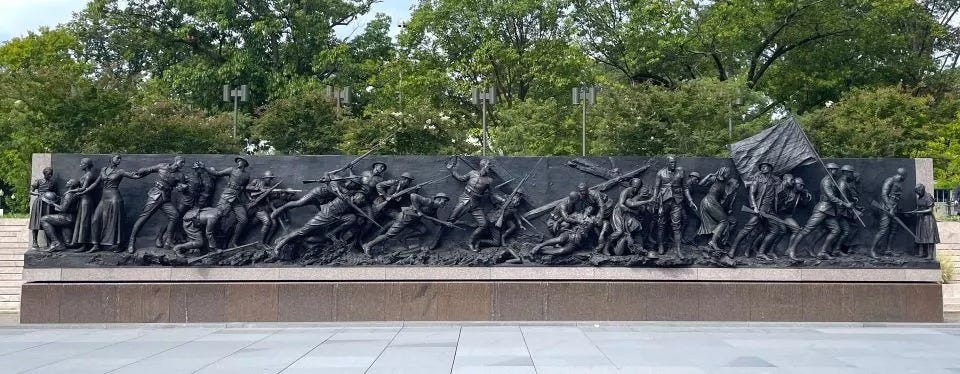
In the heart of our nation's capital, Sabin Howard's A Soldier's Journey stands as more than sculpture—it is prophecy cast in bronze. Thirty-eight figures stretch across fifty-eight feet of searing truth, each face etched with the terrible mathematics of war: hope minus innocence equals survival.
This is not your grandfather's sanitized war memorial. Howard's masterpiece forces us to confront the full arc of human transformation under fire. We witness the naive young man kissing his family goodbye, his chest swelling with patriotic fervor—a scene that could be any father, any son, any family torn apart by duty. We follow him through trenches where mud and blood become indistinguishable, where mothers' prayers meet bullets, where the "great heights" of human courage collide with our capacity for unspeakable brutality. The sculpture's genius lies not in glorifying war, but in revealing its paradox—how conflict simultaneously reveals our noblest and most savage selves, how the same hands that cradle babies also pull triggers.
The most haunting moment comes at the journey's end: a veteran's daughter gazing into his upturned helmet, unknowingly prophesying the next war. This child—innocent, trusting, beautiful in her curiosity—represents all of us before we learned that peace is fragile. This image crystallizes Howard's devastating insight—that we are trapped in cycles of violence, each generation discovering anew that the cost of freedom is paid in the currency of broken hearts and shattered families.
Howard has captured something journalists and historians struggle to convey: war's power to strip away civilization's veneer and expose the raw duality of human nature. In bronze, he has frozen the moment when ordinary people—teachers, farmers, dreamers—become capable of both extraordinary heroism and unthinkable horror. These are not faceless soldiers but our neighbors, our brothers, ourselves.
As a proud USAF veteran and aspiring human being, I ask you to stand before this monument not as a tourist, but as a human being. Let Howard's bronze figures speak to your heart about the preciousness of peace and the terrible cost of its absence. Then carry that weight into your daily life—into how you treat strangers, how you resolve conflicts, how you raise your children. For in our small acts of compassion or cruelty, we write the preface to the next chapter of human history.
"...we are trapped in cycles of violence." A powerful statement, Dennis. We are a curious species, capable of so much good and so much destruction.
Thanks for sharing your observations. Beautifully composed, as always. I've tried to follow the progress of this memorial and will keep it in mind as I visit locations in France next week where the A.E.F. fought.
Beautifully written, Dennis, and full of insight. Sadly, or not, it falls to us veterans to see the raw truth of this, and to do what we can to end the insanity of war. Happy Memorial day my friend, and have a wonderful trip.