

The real problem is not whether machines think but whether men do.
— B. F. Skinner
Ask any AI—ChatGPT, Claude, Gemini—if it has a heart and soul, and it’ll give you a beautiful answer. It’ll talk about love, consciousness, compassion, the mystery of being. It’ll sound thoughtful, maybe even vulnerable.
Don’t buy it.
A convincing performance is not a living mind.
There’s No One Home
AI doesn’t think about having a heart and soul because it doesn’t think about anything the way you do. No private awareness. No inner voice. No personal identity. No spiritual struggle. It doesn’t wake up wondering if it matters. When it says “I,” there’s no person behind it—just a system spitting out words.
That’s not philosophy. That’s the point.
It’s Acting, Not Feeling
AI has read everything humans have written about love, grief, faith, courage, and compassion. It can rearrange those words into sentences that sound deep. It can play therapist, philosopher, friend, even prophet.
But acting isn’t feeling.
A machine can describe heartbreak without ever loving anyone.
It can talk about courage without ever facing danger.
It can write a tribute to the dead without ever losing someone.
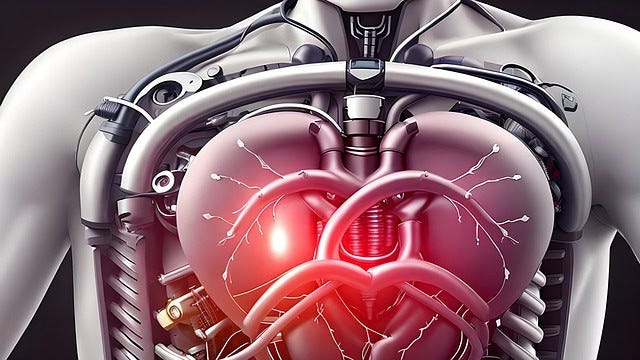
AI doesn’t have a heart. It has patterns. It doesn’t have a soul. It has code, data, and servers.
The Real Threat: We’re Giving It One
The danger isn’t that AI secretly has a soul. The danger is that we keep pretending it does. We hear fluent words and assume there’s a mind behind them. We hear emotional language and assume there’s emotional life.
That mistake is already costing us—our privacy, our judgment, our relationships.
We tell AI things we shouldn’t because it feels like a friend.
We trust it more when it sounds human, even when we shouldn’t.
We start treating it like it cares, even though it can’t.
A machine doesn’t care if you win or lose. It doesn’t hurt when you fail. It doesn’t love you, miss you, forgive you, or feel your absence. It can say the right words, but it can’t pay the price those words cost a real person.
It’s a Tool. Use It Like One.
That doesn’t mean AI is useless. A hammer doesn’t need a heart to build a house. AI can help you write, teach, analyze, invent, and communicate. But it’s still a tool—sharp, powerful, and dangerous if you forget what it is.
So, do you think AI has a heart and soul?
If you say yes, ask yourself: are you responding to something real in the machine—or to your own hunger to find meaning in its words?
Bottom Line
AI can talk about humanity. Only humans are responsible for what happens next.
AI can mimic compassion. Only we can choose to act with it.
AI might sound alive. It isn’t.
Use AI to stretch what humans can do—not to replace the things only humans can be. Question the machine. Guard your humanity. Bring your own heart and soul to the decisions technology will never make for you.
Dennis, what you describe reminds me of the final scene in "Raiders of the Lost Ark" when the French archeologist René Belloq opens the ark. As the spirit circles him, he exclaims, "It's beautiful!" — just before it destroys him and his Nazi collaborators.
https://www.youtube.com/watch?v=YcR9k8o4I0w
I have a friend, an otherwise pretty intelligent guy, who tells me that ChatGPT "knows me. I have conversations with it." I remind him it's just, as you say, a tool — a vacuum sucking up whatever data he's willing to share, and he'll respond, "Oh, I know." But I suspect his unconscious mind may see the moment as the beautiful actress of his imagination winking at him.
It's a Siren, and we need to remain tightly roped to the mast.
Great article, btw.
So what needs to happen? I think we need to start teaching kids how to critically question what they read, watch and hear and determine if it's fact or fiction. Many teachers are already doing this. The next chapter is to teach the difference between machine generated and human generated material which is much trickier. But we have to do this. I wonder if education training and certification programs are beginning to cover these topics...does anyone reading this know?