

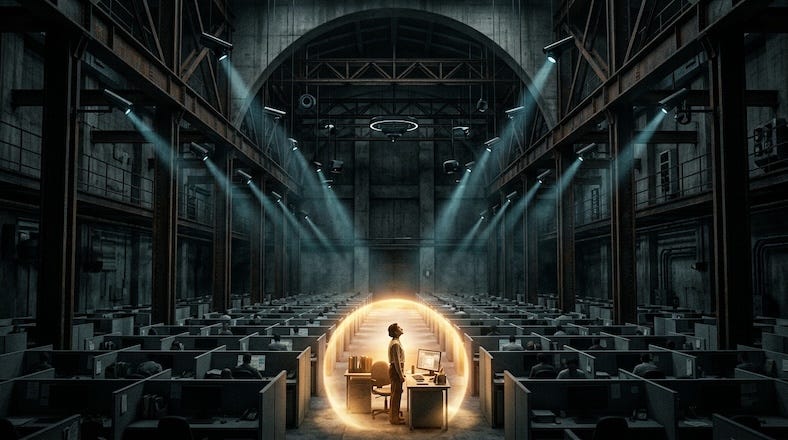
The modern office is a temple where we worship the false god of productivity while sacrificing our humanity on the altar of efficiency.
— Unknown
Walk into almost any corporate office on a Tuesday morning, or log into the endless mosaic of video meetings, and look closely at what is happening. What you are witnessing is not a collaborative engine of creative brilliance. It is a cathedral built for extraction.
The architecture of modern work was not designed to help people thrive, innovate, or build enduring value. It was engineered over a century ago during the soot-choked dawn of the Industrial Revolution, when management theorists like Frederick Winslow Taylor decided that human beings were fundamentally unreliable, deceitful cogs in an industrial machine. Taylor’s premise was simple: strip workers of independent judgment, standardize every micro-movement, surveil their output down to the second, and treat their bodies as raw material to be burned for fuel.
Look around your organization today. We traded Taylor’s stopwatch for digital keystroke monitors. We traded factory floor whistles for badge swipes, automated presence indicators, and calendar algorithms that pack nine consecutive hours with performative status updates. The tools got shinier, but the underlying assumption never changed: management believes that unless people are watched, coerced, and measured constantly, they will steal company time.
This mindset has turned our workplaces into spiritual wastelands.
We bring whole, complex, creative human beings into organizations, hand them a lanyard, and demand that they check their judgment, their empathy, and their sanity at the security turnstile.
Consider what this extraction model actually costs:
It paralyzes real innovation. Groundbreaking ideas require risk, intellectual play, and the freedom to fail without facing career execution. Surveillance and paranoia do not produce breakthrough products; they produce terrified compliance. People optimize their entire workday around self-defense.
It manufactures performance theater. When physical presence or digital availability is rewarded above genuine outcome, employees become master actors. They learn how to juggle email threads, keep Slack dots green, and sound furiously occupied while producing absolutely nothing of lasting substance.
It drives away your sharpest minds. Capable, sovereign thinkers do not tolerate being treated like untrustworthy children. The moment they realize an organization measures seat time instead of value, they pack their institutional knowledge and walk out the door.
Treating people like mechanical units of production was always morally bankrupt. But in an economy undergoing rapid technological transformation, it is also organizational suicide. Every routine, mechanical, rule-bound process is being automated or handed to intelligent software. The only sustainable advantage an organization has left is what makes its people distinctively human: creative bravery, ethical judgment, deep intuition, and the capacity for genuine trust.
You cannot extract those qualities through managerial surveillance. You cannot threaten an exhausted, cynical workforce into creative brilliance. Those human capabilities emerge only when leaders dismantle the extraction machine and build an environment grounded in dignity, psychological safety, and radical trust.
If your workplace requires people to surrender their humanity just to survive the workday, your operating model is broken. It is time to stop genuflecting to outdated industrial dogma and start building organizations fit for real human beings.
This article is adapted from my forthcoming book, Humanity Rising: Killing the Corporate Cult, which will be released on January 12, 2027. 100% of the net proceeds from book sales and speaking engagements will be donated through our GoodWorks 360° social enterprise to a 4-star rated nonprofit.
The corporate world is broken, and it won’t fix itself. This isn’t simply about selling a book. The change my book calls for is long overdue—and I can’t carry it alone. There are two ways to help: join the launch team and help put this message in front of the people who need it most, or reserve your copy for January 12, read it, and pass it along. Help me kill the Cult.
JOIN THE TEAM | RESERVE YOUR COPY
Dennis you hit the nail squarely on the head. The system is and has been broken for decades. Your line the work place is a "cathedral built for extraction."
Micromanaging never worked well. When the politics and big business create chaos and conspire to instill fear that your job and you are expendable people will often stay. However when innovative people have had enough, when we are are finally sick and tired of being sick and tired. Change will occur.
Change because the best people leave. New ideas, products, and solutions work when good people collaborate.
We have seen industry titans disappear of become severely diminished. A&P, Digital Equipment Corp (DEC), Blackberry, Kodak, the original AT&T and countless others.
Your book will be the walk up call, the rallying point for action and real change.
Dennis, I wonder how much of what we’re trying to change in workplaces begins with the metaphor we use to understand them.
We’ve inherited a powerful idea of the organisation as a machine, with people as resources to be managed, processes to be optimised and performance to be extracted.
What might change if we began exploring different metaphors? An organisation as a community, a movement, a thriving city, even a safe home?
Each might reveal possibilities the machine metaphor obscures.
And perhaps we’d begin with a different question: what would it take for everyone here to thrive?
Not thriving at someone else’s expense, but through creating genuine value for others — colleagues, customers, communities and the wider world.
Imagine people across an organisation inquiring into that question together, rather than having another culture-change programme designed for them.
I wonder what they might discover that none of us could prescribe in advance.