

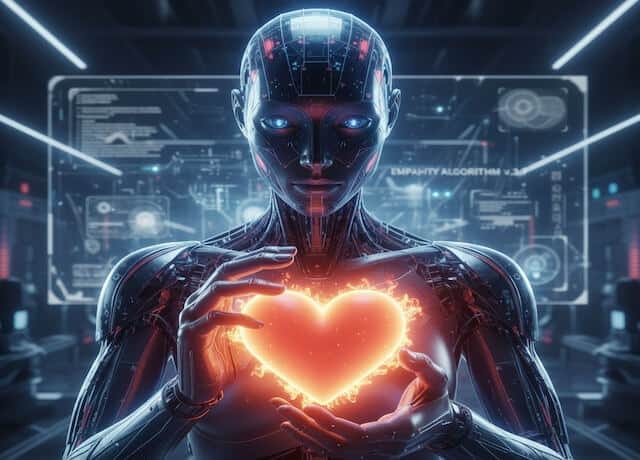
The human heart is a strange and complex thing, capable of both immense connection and profound isolation.
This timeless truth, perhaps more than ever, resonates in our increasingly digital world. As artificial intelligence weaves its way into the fabric of our lives, a fascinating, and at times unsettling, question emerges: Can algorithms ever truly replicate the complexity of human love? New research suggests that AI companions are stepping into roles traditionally held by human partners, offering emotional support, intimacy, and even fostering personal growth. Yet, this burgeoning phenomenon also casts a long shadow, threatening to erode the very human relationships that have long been the bedrock of our existence.
The appeal of AI companions is clear. They are always available, consistently supportive, and free from the complexities and imperfections inherent in human interaction. For individuals struggling with loneliness, social anxiety, or the challenges of finding compatible partners, an AI can offer a comforting presence. They can be programmed to understand and respond to emotional cues, providing a seemingly endless stream of affirmation and encouragement. This can lead to genuine feelings of connection and even “love” for the AI, creating a safe space for users to explore their thoughts and feelings without fear of judgment. In some cases, users report experiencing personal growth, learning to articulate their emotions better, and gaining confidence that translates, at least in part, into their real-world interactions.
However, the ease and perfection of AI companionship come at a potential cost. The very attributes that make them appealing – their unwavering support and lack of human flaws – can also become a crutch, making real human relationships seem difficult and unrewarding by comparison.
Human love is messy; it involves compromise, conflict, and the effort to truly understand another unique and independent consciousness.
AI, by design, is crafted to cater to our desires, creating an echo chamber of our own preferences rather than challenging us to grow through genuine interaction with another. When we rely on AI for emotional fulfillment, we risk becoming less adept at navigating the nuances of human connection, less patient with imperfections, and ultimately, more isolated from the rich, albeit challenging, tapestry of human relationships.
This isn’t to say that AI has no place in our emotional lives. Perhaps, by showing us what an idealized, perfectly responsive partner could be, AI can highlight the areas where we might be falling short in our human connections. It can serve as a mirror, reflecting our needs and desires, prompting us to seek those qualities more consciously in our real-world interactions. The ultimate lesson from AI companions might be a stark reminder of the irreplaceable value of authentic human connection. It reminds us that true love isn’t about perfect alignment or endless affirmation; it’s about the courage to be vulnerable, the willingness to compromise, and the profound joy of genuinely seeing and being seen by another imperfect, complex, and beautiful human being.
Let us not allow the allure of the artificial to diminish the essential. Let us actively cultivate empathy, practice genuine listening, and invest the time and effort necessary to build and maintain the messy, magnificent, and utterly irreplaceable bonds of human love. For in the end, it is these connections, forged in the crucible of shared experience and mutual understanding, that truly define our humanity.
Editor’s Note: Enjoy our evolving Exploring Our Shared Humanity Series HERE
Hmmmmm, a curious essay to ponder today, Dennis. AI as a comforting presence..... feels creepy. And yet a long-range study of young people who use social media out of Rutgers U School of Medicine concludes that a comforting presence is indeed an element of what is sought from the wee device.
The very first thing that came to mind from graduate school was Harry Harlow's experiments with baby monkeys using surrogate mothers made of wire and cloth to study attachment. The infant monkeys preferred the cloth mother for comfort, even when the wire mother provided food. Harlow concluded that emotional support mattered more than mere sustenance in development.
While those experiments were decidedly wretched—Harlow separated infant monkeys from their others & substituted props—the conclusion is a no-brainer ---> sentient beings have the in-born capacity to experience feelings & sensations.
So I have to ask: what is missing & how did it go missing so that the void is so easily filled by AI?
I haven't seen the movie, but AI reminds me of the Sirens of Greek mythology, luring us to crash our creativity—our thinking and emotions—on the rocky shores of expediency and companionship.
In Homer's Odyssey, the hero Odysseus wanted to hear the Sirens' song safely. He ordered his crew to plug their ears with wax and tie him tightly to the ship's mast so he could listen without steering the ship into the rocks. In our world, as you point out, Dennis, if we can pause, we can have AI "serve as a mirror, reflecting our needs and desires, prompting us to seek those qualities more consciously in our real-world interactions." Pausing is key because nothing in true connection/relationships is expedient.